
Why Your Business Needs More Than a Website
Alen Ink perspective
Practical guidance designed to help business owners understand the decision, the tradeoffs, and the next step.
From a website to a connected business
For many businesses, a website starts as a digital brochure. It explains what the company does, shows a few services, provides contact information, and gives potential customers a way to reach out. That is a good starting point, but as a business grows, a basic website usually is not enough.
A modern business needs more than a polished homepage. It needs systems that help the company operate better. That can include client portals, internal dashboards, intake forms, project tracking, invoice visibility, workflow automation, customer records, and reporting tools.
What happens after someone clicks?
The difference between a website and a business system is what happens after someone clicks a button. A basic contact form sends an email. A smarter system can create a lead, notify the right person, log the request, assign follow-up tasks, generate a summary, and keep the customer updated.
This is where custom software becomes valuable. Instead of forcing your team to manage everything through spreadsheets, inboxes, text messages, and disconnected apps, a custom platform can bring the work into one organized place.
Give customers and your team one place to work
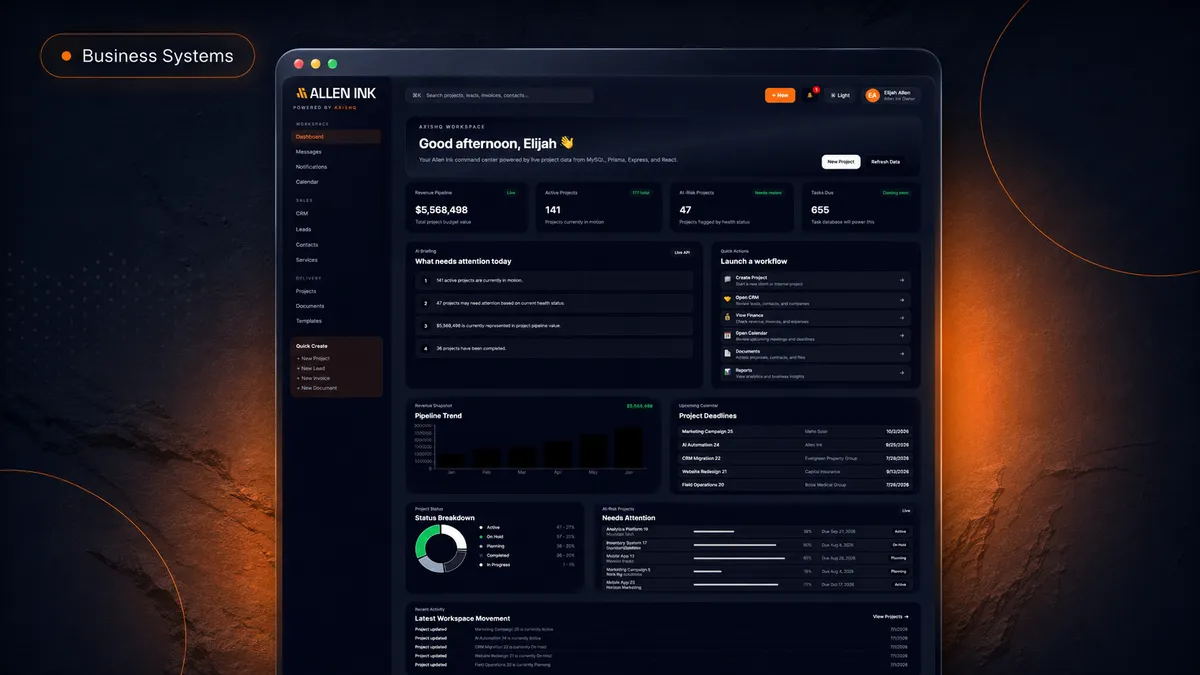
For example, a service business might need a client portal where customers can log in, view project updates, upload files, approve quotes, and see invoices. Internally, the team might need a dashboard that tracks active projects, revenue, outstanding tasks, support requests, and upcoming deadlines.
Use automation to reduce repetitive work
Automation can also reduce repetitive work. A form submission can trigger a confirmation email, create a database record, assign a task, notify the team, and prepare an AI-generated summary. This saves time and helps prevent important details from being missed.
Dashboards give leadership better visibility. Instead of waiting for someone to update a spreadsheet, decision-makers can see real-time data about leads, projects, revenue, clients, and operations. That visibility makes it easier to spot bottlenecks and make better decisions.
Start with the workflow causing the most friction
The goal is not to overbuild from day one. The best approach is to start with the workflow causing the most friction. That might be client intake, project tracking, billing, reporting, scheduling, or customer communication. Once that process is improved, the system can grow in phases.
Build a website that can grow with your business
At Allen Ink, the focus is building websites, software, portals, dashboards, and automation around how a business actually works. A website should still look professional, load quickly, and represent the brand well. But it can also become the front door to a much more powerful business system.
If your business is relying on spreadsheets, manual follow-ups, disconnected tools, or outdated workflows, it may be time to think beyond a website. The next step may be a connected platform that helps your business save time, improve visibility, and support growth.
Go deeper on this topic
Allen Ink Knowledge Hub
Need help applying this?
Turn the article into a practical growth plan for your business.
Allen Ink can help connect website design, SEO, local visibility, AI-search readiness, content, and automation into one implementation plan.
