
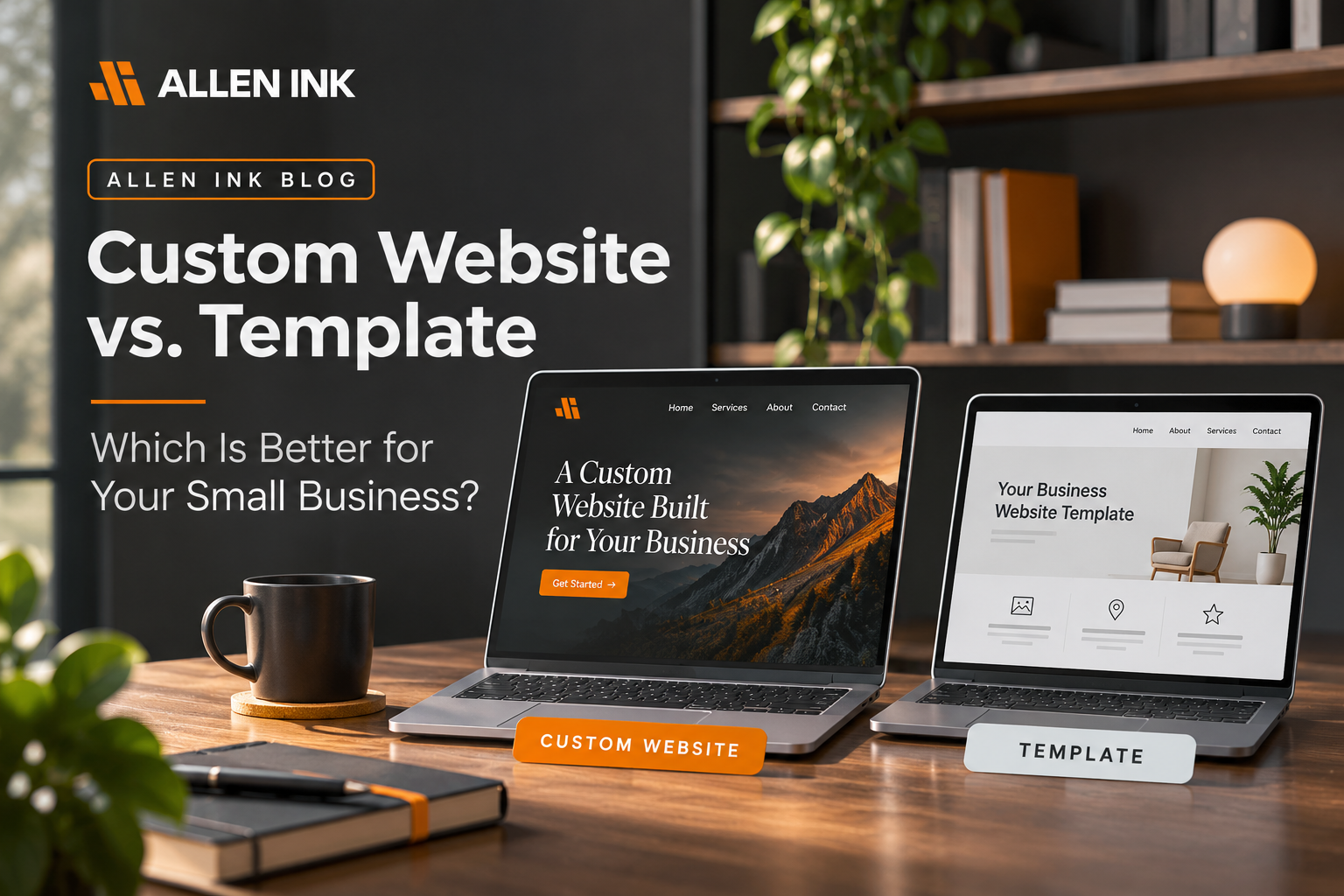
Custom Website vs. Template: Which Is Better for Your Small Business?
A practical guide to choosing a website that fits your business, budget, and growth goals.
Your website is often the first serious interaction a potential customer has with your business.
Before someone calls, requests a quote, schedules an appointment, or visits your location, there's a good chance they've already checked out your website.
That raises an important question for small business owners:
Should you invest in a professionally designed custom website, or is a website template good enough?
The answer isn't as straightforward as some web design companies would have you believe.
A custom website isn't automatically better. A template isn't automatically cheap-looking or ineffective. What matters is how well your website supports your business, serves your customers, and creates opportunities for growth.
At Allen Ink, we help small businesses build professional websites designed around their needs. Here's how to determine which approach makes the most sense for yours.

What Is a Website Template?
A website template is a pre-designed layout that provides a starting point for building a website.
Platforms such as WordPress, Wix, Squarespace, and other website builders offer templates that can be customized with your business name, logo, colors, images, and content.
For many businesses, this is an accessible way to establish an online presence.
Advantages of website templates
Lower initial cost: Existing layouts reduce the amount of original design work required.
Faster setup: Basic websites can often be launched relatively quickly.
Established features: Many templates include navigation menus, contact forms, and responsive layouts.
Simpler content management: Website builders often make basic content updates straightforward.
Templates can be a practical choice for a new business with limited content, straightforward services, and a modest budget.
Potential disadvantages
Templates also have limitations, depending on the platform and the design selected.
A business may encounter difficulty adapting an existing layout to its services, presenting complex information, or creating a distinctive brand experience.
Some templates contain unnecessary functionality, excessive scripts, or design elements that make optimization more difficult. Others are well engineered and perform exceptionally well.
The template itself isn't necessarily the problem.
The real problem occurs when a business chooses a website based on appearance rather than its customers' needs.

What Is a Custom Website?
A custom website is designed or developed around specific business requirements rather than simply adopting an existing website layout.
Customization can involve original page designs, tailored content structures, unique visual elements, specialized integrations, or custom functionality.
Importantly, a custom website doesn't necessarily require a completely proprietary platform or every line of code to be written from scratch.
Professional web designers can combine established technologies with custom layouts, carefully selected components, and business-specific functionality.
The objective is to create a website that fits the business instead of forcing the business into a predetermined design.
For example, a local roofing contractor may need prominent estimate-request buttons, service-area information, project galleries, and clear explanations of roofing services.
A dance studio might need class information, schedules, registration options, and performance details.
These businesses have very different customer journeys. Their websites should reflect that.
Custom Website vs. Template: A Side-by-Side Comparison
Feature | Template Website | Custom Website |
|---|---|---|
Initial investment | Often lower | Often higher |
Design flexibility | Depends on template and platform | Generally greater |
Launch timeline | Can be faster | Depends on scope |
Brand differentiation | Requires customization | Can be designed around the brand |
SEO capabilities | Can be excellent | Can be excellent |
Performance | Depends on implementation | Depends on implementation |
Future expansion | Depends on platform limitations | Can be planned around specific needs |
Maintenance | Platform and setup dependent | Architecture and support dependent |
The biggest takeaway is that neither approach guarantees better results.
A professionally implemented template can outperform a poorly developed custom website.
Likewise, a well-planned custom website can offer significant advantages when a business has requirements that an existing template doesn't handle effectively.
5 Signs Your Small Business May Benefit From Custom Website Design
1. Your website doesn't clearly explain what you do
Imagine visiting a business website and having to search through several pages just to understand its services.
Most potential customers won't work that hard.
A strong website should quickly communicate who the business serves, what it offers, and what visitors should do next.
Custom website design allows page layouts and content to be organized around those priorities.
2. Your website looks too similar to competitors
Small businesses compete for attention in crowded markets.
If your website looks nearly identical to every other company in your industry, you may be missing an opportunity to communicate what makes your business different.
Professional design can bring together distinctive typography, photography, colors, messaging, and page structures.
The objective isn't simply to look different.
It's to communicate your value more effectively.
3. Your customers struggle to use your website on mobile
Many customers research businesses on their smartphones.
If visitors have to zoom in to read your content, struggle with navigation, or can't easily find your contact information, those frustrations can interfere with inquiries.
A mobile-friendly website should provide readable content, accessible navigation, usable forms, and clear calls to action.
Both templates and custom websites can accomplish this. What matters is testing the finished experience.
4. Your website isn't generating meaningful inquiries
A website can look attractive without helping your business acquire customers.
Common problems include unclear service descriptions, buried contact information, weak calls to action, and confusing navigation.
Before investing in a redesign, evaluate the journey visitors take.
Can someone quickly determine whether you provide the service they need?
Can they find reasons to trust your business?
Can they contact you without unnecessary steps?
If the answers are no, your website may need more than a cosmetic update.
5. Your current platform limits your business
As businesses grow, their website requirements can change.
You may need more sophisticated service pages, appointment scheduling, customer-management integrations, expanded content, or additional functionality.
Sometimes these requirements can be handled with existing plugins or modest improvements.
Other times, a more tailored website structure makes sense.
The key is determining which limitations are real before committing to a full rebuild.
Is a Custom Website Better for SEO?
One of the most common misconceptions in website design is that custom-built websites automatically rank higher on Google.
They don't.
Search engine optimization depends on many factors, including relevant content, website structure, crawlability, page experience, and the usefulness of the information provided.
Google doesn't award higher rankings simply because a website uses custom code instead of a template.
A template-based website can perform exceptionally well in search when properly configured and maintained.
Similarly, a custom website can struggle with SEO if it contains technical errors, poor content, confusing navigation, or indexing problems.
What actually matters for website SEO?
For small businesses, important fundamentals include:
Clear service pages that address what customers are searching for.
Descriptive page titles, headings, and URLs.
Mobile-friendly layouts and intuitive navigation.
Appropriate internal links between related pages.
Optimized images and efficient page loading.
Search-engine-accessible content and proper indexing.
Accurate business information and relevant local content.
A well-designed website should make it easy for both visitors and search engines to understand your business.
For companies competing in local markets such as Boise, Meridian, Eagle, and Nampa, geographic relevance can be especially important.
A Boise roofing contractor, for example, benefits from clearly explaining its actual services and the communities it serves—not from repeating "Boise roofing" dozens of times throughout the site.
Learn more about Allen Ink's SEO services.
How Much Should a Small Business Website Cost?
Website pricing varies considerably depending on the project.
A simple informational website has different requirements than an e-commerce store, membership platform, or business website with custom integrations.
Rather than comparing prices alone, consider what each proposal actually includes.
Does the quoted price cover:
Professional website design and development?
Mobile-friendly implementation?
Basic on-page SEO setup?
Contact forms and lead-capture functionality?
Hosting and website security?
Website updates and ongoing maintenance?
Future revisions or additional pages?
A lower upfront price doesn't always translate into a lower long-term cost.
However, a higher price doesn't automatically provide greater value either.
The right investment is one that delivers the capabilities your business needs at a cost you can realistically sustain.
What about monthly website plans?
For businesses that prefer to preserve working capital, a monthly website plan can provide another option.
Instead of paying the entire website development cost upfront, the expense may be spread across scheduled payments, depending on the provider and agreement.
Before choosing a monthly plan, review the contract length, total cost, included services, ownership terms, and what happens if you cancel.
Allen Ink offers both website purchase options and monthly website solutions.
Explore our website pricing and packages to compare available options.
When Is a Website Template the Smarter Choice?
Custom design is not necessary for every business.
A professionally implemented template may be the better investment when:
You're launching a new business with a limited budget.
You need a straightforward website with a few essential pages.
Your services and customer journey are relatively simple.
You don't require unusual functionality or integrations.
The template can support your branding and content without excessive modifications.
In those situations, spending additional money on features customers don't need may be difficult to justify.
A well-designed, focused website is often more useful than an unnecessarily complicated one.
When Is a Custom Website Worth the Investment?
Custom website design becomes more compelling when your business has specific needs that existing layouts or platforms cannot address efficiently.
This might include distinctive branding, specialized functionality, complex service information, or a more deliberate customer experience.
It can also make sense when your existing website has become difficult to manage or expand.
But the decision should always come back to the same question:
What will the additional investment help your business accomplish?
If you can't clearly explain the answer, you may not need a more expensive website.
You may simply need a better strategy for the website you already have.
How to Choose the Right Website for Your Business
Before committing to any website design project, ask yourself five questions:
What is the primary purpose of my website? Generate leads, sell products, provide information, book appointments, or something else?
Who am I trying to reach? Understand the questions and concerns your ideal customers have.
What isn't working with my current website? Identify usability problems, outdated content, missing functionality, or weak messaging.
What features do I genuinely need? Separate essential capabilities from features that would simply be nice to have.
What can my business comfortably invest? Consider both initial costs and long-term support.
These questions provide a stronger foundation than choosing a website solely because a demo looks impressive.
The Allen Ink Approach to Small Business Website Design
At Allen Ink, we believe a business website should do more than look professional.
It should clearly explain your services, establish credibility, make information easy to find, and help interested visitors take the next step.
Our approach emphasizes mobile-friendly design, clear messaging, usability, SEO fundamentals, and practical ongoing website support.
Whether you're launching your first website or considering a redesign, the objective is the same: create a website that supports your actual business goals.
We work with small businesses in Boise, Meridian, and throughout the Treasure Valley, as well as businesses in other markets.
Ready to Build a Better Website?
If you're debating between a website template, a custom design, or improving your current website, start by identifying what your business actually needs.
Allen Ink can help you explore website design options and determine which approach fits your goals and budget.
Explore Our Website Design Services
Frequently Asked Questions
Is a custom website better than a template?
Not necessarily. A custom website can provide greater design and functionality flexibility, while a well-built template can meet many small business needs. The best choice depends on your requirements, budget, and long-term goals.
Are website templates bad for SEO?
No. Website templates can support strong SEO when implemented correctly. Search performance depends on factors such as content quality, crawlability, site structure, and technical implementation rather than whether the layout began as a template.
Can I redesign my website without changing platforms?
Often, yes. Many website platforms support substantial design and content improvements without requiring a full migration. The available options depend on your current platform and website configuration.
How long does it take to build a small business website?
Timelines vary based on the number of pages, content readiness, design requirements, functionality, and approval process. A straightforward informational website generally requires less work than a complex custom platform.
Should a new small business invest in a custom website?
A new business should first determine what its website needs to accomplish. A professionally designed starter website may be sufficient initially, while businesses with specialized requirements may benefit from additional customization.
